AViCeMIS goal
Towards new in vivo behaviour animal models through Active Vision, based on C. elegans fully automatic Manipulation, Imaging and Screening.
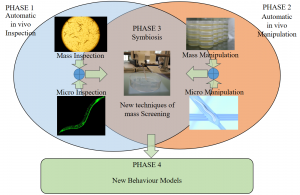
Despite the excellent progress in the last decade [1], there are a few hurdles for greater acceptance of the technology by mainstream C. elegans labs. At present, the technical know-how about micromanipulation systems and the infrastructure needed to produce devices is restricted mainly to labs with significant engineering expertise. Other hurdles include the high cost of fabrication, the need for customized hardware and software to process data, and the manual work required to operate many of the devices. Overcoming these barriers will require training the next generation of C. elegans scientists to be comfortable with fabricating and operating custom micro devices.
All areas of C. elegans research have been miniaturized, but there are a few where growth has been impressive. These include in vivo analysis of neuronal function, longitudinal studies of gene expression and age-related processes. Among the various approaches, the electrotaxis response is a promising tool to manipulate worms in different ways including sorting, transport and exercise treatments. We expect to develop a lot more progress in these directions, including improved devices for characterization of disease models and gene target identifications that are relevant to humans.
References:
[1] Gupta, B. P., & Rezai, P. (2016). Microfluidic Approaches for Manipulating, Imaging, and Screening C. elegans. Micromachines, 7(7).