MULTI-VIEW V2
The prototype [1] has now been updated and improved to offer better macro and micro image resolutions, better control of the motors and better experiment developing. Now MultiView V2 is shown as a more reliable and professional product.

New tracking and focusing modules integrate YOLOv8-based macro tracking, identity-preserving skeletonization for aggregations, closed-loop micro focusing via a CNN depth-to-focus estimator, and ROS2-driven XY–Z stage control.
Using the micro sequences captured by the system, a neural re-identification pipeline achieves robust strain discrimination and identity maintenance across long recordings.
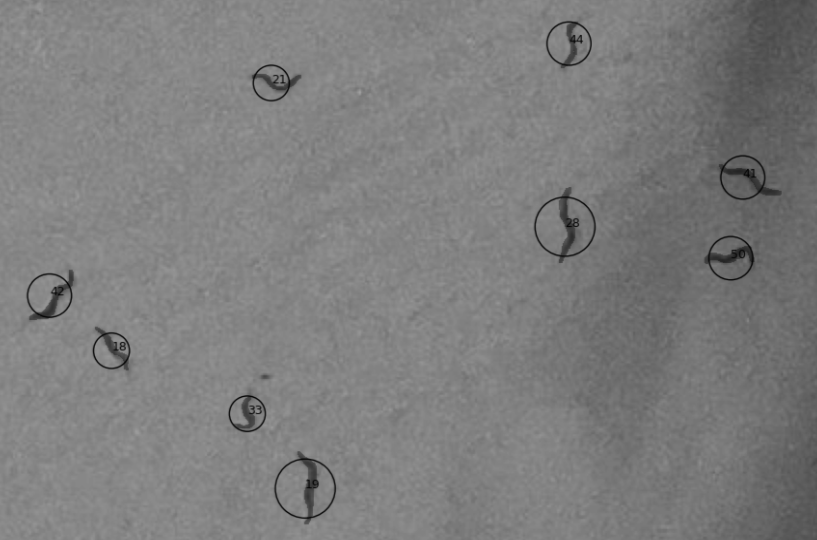
To ensure that the identification network learns worm-intrinsic features, individuals are first straightened prior to inference.
The most relevant outcome of Multiview V2 is the demonstration that imaging resolution critically determines the system’s discriminative capacity. Traditional statistical descriptors and centroid-based analyses failed to detect differences between the N2 and RVM66 strains, but the same CNN–Transformer architecture trained with high-resolution micro-camera sequences achieved over 75% accuracy, revealing subtle locomotion patterns invisible at macro scale. This result validates Multiview V2 as a high-sensitivity phenotyping platform for behavioural studies in C. elegans.

References
[1] Puchalt, J. C., Gonzalez-Rojo, J. F., Gómez-Escribano, A. P., Vázquez-Manrique, R. P. & Sánchez-Salmerón, A.-J. Multiview motion tracking based on a cartesian robot to monitor caenorhabditis elegans in standard petri dishes. Sci. Reports 12, DOI: 10.1038/s41598-022-05823-6 (2022).
[2] Kounakis, K., Castro, P. E. L., Garvi, A. G., Sánchez-Salmerón, A. J., & Tavernarakis, N. (2025). Automated Analysis of C. elegans Fluorescence Images using SegElegans. Journal of Visualized Experiments (JoVE), (224), e69094.
[3] García-Garví, A., & Sánchez-Salmerón, A. J. (2025). High-throughput behavioral screening in Caenorhabditis elegans using machine learning for drug repurposing. Scientific Reports, 15(1), 26140.
[4] Castro, P. E. L., Kounakis, K., Garví, A. G., Gkikas, I., Tsiamantas, I., Tavernarakis, N., & Sánchez-Salmerón, A. J. (2025). SegElegans: Instance segmentation using dual convolutional recurrent neural network decoder in Caenorhabditis elegans microscopic images. Computers in Biology and Medicine, 190, 110012.
[5] Layana Castro, P. E., García Garví, A., Navarro Moya, F., & Sanchez-Salmeron, A. J. (2023). Skeletonizing Caenorhabditis elegans based on U-Net architectures trained with a multi-worm low-resolution synthetic dataset. International Journal of Computer Vision, 131(9), 2408-2424.
[6] Castro, P. E. L., Garvi, A. G., & Sanchez-Salmeron, A. J. (2023). Automatic segmentation of Caenorhabditis elegans skeletons in worm aggregations using improved U-Net in low-resolution image sequences. Heliyon, 9(4).
[7] Garcia-Garvi, A., Layana-Castro, P. E., Puchalt, J. C., & Sanchez-Salmeron, A. J. (2023). Automation of Caenorhabditis elegans lifespan assay using a simplified domain synthetic image-based neural network training strategy. Computational and Structural Biotechnology Journal, 21, 5049-5065.
[8] Escobar-Benavides, S., García-Garví, A., Layana-Castro, P. E., & Sánchez-Salmerón, A. J. (2023). Towards generalization for Caenorhabditis elegans detection. Computational and Structural Biotechnology Journal, 21, 4914-4922.
[9] Garcia-Garvi, A., Layana-Castro, P. E., & Sanchez-Salmeron, A. J. (2023). Analysis of a C. elegans lifespan prediction method based on a bimodal neural network and uncertainty estimation. Computational and Structural Biotechnology Journal, 21, 655-664.